Is the Church abandoning its flock?
Love Giles
You are a very engaging writer, and I often enjoy reading your pieces. You lot take a bang-up plow of phrase, and there are times when you are able to cutting through all the complexity and dissembling, and hit the nail on the head (if you don't heed me mixing my metaphors somewhat).
But much of the time, your articles are an admixture of this insight along with your frustration—anger even—and downright errors. I never quite know whether these errors are unintended, and ascend from lack of understanding, or whether you lot are deliberately deciding to be economical with the truth. Your recent broadside 'The Church is abandoning its flock' is a case in betoken.
You brainstorm:
There are some forms of Christianity that be merely in order to reproduce. Christians are here to make new Christians who, in plow, are called to go out there and make even more new ones. The purpose of church building life is to afford more than church life.
No, there are not 'some forms' of Christianity like this: all forms are like this, if they truly are reflections of the Christ they claim to follow. One of Jesus' primary images of his followers comes from his 'Last Supper' or 'Good day Discourse':
"I am the true vine, and my Male parent is the gardener. He cuts off every branch in me that bears no fruit, while every co-operative that does comport fruit he prunesand so that it will be even more fruitful" (John xv.1).
Although Jesus is here addressing the Twelve (though at that place announced to have been others in the Upper Room too), this has never been read as an exclusive delineation of them as leaders. It is an prototype of everyone who believes in him. If we abide (make our habitation) in him, then we will comport fruit, much fruit—but if nosotros are unfruitful we do non and cannot remain in him. 'Fruit' here does insinuate to quality of life, and St Paul extends the metaphor in Gal 5.22 to describe the things of the Spirit—simply the root of the metaphor is that fruit contains seeds, and seeds give ascension to more plants which produce more fruit. Like and then many of Jesus' agronomical parables in the gospels, information technology is an image of reproduction.
In one of my favourite verses in the gospels, Marking 4.28, Jesus describes the growth of the kingdom as like a seed that grows automatically, 'all past itself', demonstrating the sovereign purposes of God in achieving his goals. Simply in the surrounding verses and the surrounding parables, Jesus is clear that (contrary to what you announced to presume) the growth of God's people and the adept news doesnot happen automatically. A sower must go out to sow; the farmer scatters seed on the ground.
Thus Jesus says to the Gerasene demoniac "Go home to your own people and tell them how much the Lord has done for you, and how he has had mercy on you" (Mark 5.xix). A repeated theme of the first half of Marker'due south gospel is that 'news about him spread rapidly' (Mark 1.28) because many who had encountered him did just that. Yes, in that location is a contrast with the more sober ethos of the 2nd one-half of the gospel, simply that does not nullify the first. In fact, a very similar matter happens in the Acts of the Apostles, when the believers, scattered by the persecution of the Jerusalem church, 'preached the word wherever they went' (Acts viii.4). In doing so, deliberately or by accident, they were fulfilling the committee of Jesus 'You shall exist my witnesses…to the ends of the earth' (Acts one.8)—again, a command or invitation issued to apostles, but e'er taken every bit paradigmatic for all believers.
It is no surprise, and then, that one of these apostles writes to all 'in the diaspora' that they should exist 'always exist prepared to requite a reasoned account [apologia] for the hope that is inside you lot] (1 Peter 3.15). Why do you call back that this should just apply to 'some' Christians?
You then decry the new initiative publicised last week:
The new growth strategy from head office is code named Myriad, Greek for 10 thousand. The idea is to have 10,000 new churches by 2030, creating a meg new disciples. Don't worry most the figures too much, they are nothing more than fantasy numbers plucked from the sky. As a general rule, church building growth is inversely proportional to the big talk coming from head role.
But of class it is not that new, and it doesn't come up from 'head office'; this is your paranoia speaking. Anglicans accept been planting churches for hundreds of years; this is how the global Anglican Communion came into being, considering Anglicans from here went effectually the world taking the good news well-nigh Jesus as the Church of England has received it. David Pytches was a bishop in South America, and saw the importance of church planting, and brought that experience back to England in 1977 when he became vicar of St Andrew's, Chorleywood. His vision there gave rise to the New Wine movement, who are partners in this church planting initiative, so the wheel has turned full circle.
Only recall virtually the building in which yous minister. Where did it come from? Someone, former in the by, planted a church. Many of our Victorian and Edwardian buildings started life as 'tin tabernacles', prefabricated kits to allow Anglicans to found churches in the growing towns and suburbs around the expanding cities of the industrial revolution. This is hardly a 'new thing from head office'!
I agree with you on ane thing though: initiatives perceived every bit coming 'from head office' won't go very far. The Decade of Evangelism didn't have the event it might take washed, considering we turned it into the Decade of Liturgical Revision (funny how rearranging the furniture of a sudden becomes and then attractive for Anglicans when the alternative is talking to people most Jesus) though there was a shift in culture and important things were learnt. (Ane evaluation contains the priceless phrase 'bishops may not seem to affair a great deal…'!)
Every bit this commodity, and your ain profile, demonstrate, getting clergy to do anything is similar herding cats. That is why Myriadisn't a 'strategy from head part'; it is a ground level initiative that will aim to work from the bottom upward, not the peak downwards, and that has been fabricated clear in all its piece of work.
I hold with you 'that all efforts to put evangelism first are self-defeating.' Evangelism and witness tin can never happen just because someone tells us it must. Information technology can only happen when people run across God at work in their lives and are excited enough to tell others most it. We would probably cringe in understanding at some of the things I remember beingness told in my evangelical youth, and (like many evangelicals) I have wrestled with the guilt trip of working out why I have non seen a succession of people dramatically come to faith as others announced to have. The simply respond is that I am not an evangelist—not that many people are—but like all followers of Jesus I am called to be a witness. This is reflected, from the very starting time, in Acts; here we find both an account of the loftier-contour ministries of the leaders of the motility, but every bit important the 'gossiping of the gospel' by 'ordinary' believers. Information technology is both/and and not either/or.
I share with you the frustration yous limited at the way the leadership of the Church has responded to the pandemic, and I appreciate your willingness to throw out the claiming.
When the Archbishop of Canterbury decided to celebrate and circulate the Eucharist on Easter Day 2022 from his kitchen, rather than popping downwards a few stairs to Lambeth Palace'southward fine 13th-century chapel, he was clearly making a signal: all those quondam stones are belongings us back, they are unnecessary.
I don't accredit this decision to the conspiratorial motives that you imagine; I merely call back it was an ill-considered blunder, like many other things. Why collude with the unevidenced ban on singing, and so that it appears the viruscan exist transmitted in a church building by worshippers, justnon in a pub by football game fans? Why the ridiculous, poorly argued and contradictory prohibition on the use of individual cups in Communion, which has pushed many into the unAnglican practice of receiving in one kind only? Why the lack of high profile appointment with questions of mortality and finitude, preferring instead to be enforcers of authorities policy?
This is where I always turn to my favourite mantra nearly the Church of England:
Never ascribe to malice that which tin can exist explained by incompetence.
Like the rest of u.s.a., our bishops accept felt the pressure of this strange season; already, their jobs were impossible; and I don't get the impression that they are working well together either.
But here you weaken your own statement, first in citing the ridiculous cynicism of Martyn Percy—the Great Leap Forrard, in which millions died of starvation? How can you dare to trivialise it in this way?—and secondly in citing the current state of affairs in Winchester.
The recent defection of the Diocese of Winchester confronting their Bishop is a case in point. They threatened a vote of no confidence and he has stepped back from ministry.
Yous appear to know nothing of what has been happening there; people whoagreed with the initiatives Tim Dakin introduced were amongst those who signed the motion of no confidence. This does not appear to be a business about strategy, simply about leadership style. In pushing your conspiracy theory, you are taking 2 and 2 and 2 and making 222.
And you continue to do this in your pointing to Chelmsford:
The Diocese of Chelmsford is culling 61 posts by 2022 with a further 49 under threat past 2026. Others are following suit. But every bit these "limiting factor" clergy are being culled, central funds are being directed towards new evangelistic initiatives through what is chosen Strategic Development Funding from the £nine billion piggy bank held by the fabulously wealthy Church building Commissioners.
I agree with you that this is a disaster for any diocese, because at that place is clear research prove which shows that cutting stipendiary ministry actually undermines growth. How do I know that? Because the same 'head function' people supporting the Myriad initiative accept washed the enquiry. The issue in Chelmsford, as the suffragan pointed out in his accost to the Diocesan Synod, is that giving has not matched resource in the diocese. I recently read a disparaging annotate online near 'wealthy evangelicals who take all the money' and wanted to ask why they thought this was the instance. The answer is that evangelical clergy consistently teach near the importance of giving, where those of other traditions often squirm at the idea. What about y'all?
The ministry of the local church needs to be self-sustaining in the medium and long term, and that is true both for historical parishes and new church building plants, whether they are funded by the Strategic Development Fund or the Myriad project. You requite the impression that the costs of your stipend and the running of your church buildings should be provided 'automatically', as if past magic. They won't be, and they shouldn't be.
And there isn't the trade-off you suggest between the cutting of stipendiary clergy posts (decisions made locally, by the financially independent dioceses) and the availability of pump-priming money from the Church Commissioners (provided centrally). You are letting your cynicism trump both logic and evidence.
Your final flourish is an oft-repeated slogan: 'the church is non called to exist successful. Information technology is called to be faithful.' But true-blue to what? The paradox of the liberal Cosmic tradition in which I think you sit is that it wants to hold on resolutely to outward forms of Christian faith, many of which are not much more than than historical accidents, but negotiate abroad (often nether the pressure of the contemporary Zeitgeist) core aspects of Christian belief. It is hard non to run into this as instance of what St Paul described in 2 Tim 3.5.
The current issue over which the Church building of England is tearing itself apart is that of sexuality, in which people similar me arguing that the Church should 'remain true-blue' are the enemies of your ain position of wanting to see change.
The 'faithful remnant' whom you laud are those who have held fast to the truths of Scripture and the words of God in disobedience of the culture around them. And they have then passed this word on, and testified to the truth of who God is and what God is washed. In scripture, they are a very far cry from the Eleanor Rigby 'who lives in a dream' or the Begetter McKenzie who 'writes sermons that no-one will hear'. They live in reality, and shout it from the rooftops; I am pitiful if that is distasteful to you! Yes, belonging to the church is about being cared for, being listened to, being supported. Simply no-one ends upward in church without someone else inviting them. Why should we receive all this grace and not invite others to receive it as well? What should we think of people with staff of life eating on their ain, and not sharing it with the starving globe around them?
You lot are right in this:
[W]e won't outlast this period of history by being more business concern-like or by adopting slicker models of evangelistic marketing. We won't exist saved by panicky spread-sheet evangelists, Indeed, we must exist more of what we have been called to be – more thoughtful, more prayerful, less fearful, more obedient to God'southward call. Nosotros are resurrection people afterward all.
But what are called to exist is too sacrificial givers, witnesses of Jesus to others, and unembarrassed to walk to a different drum-beat, often out of step with the world around u.s.a.. Those who saw the empty tomb did not just 'say nada to anyone, because they were afraid' (Mark 16.8); in the power of the Holy Spirit, they 'stood up with the others, raised [their] voice, and addressed the crowd' (Acts 2.14).
Are you up for that?
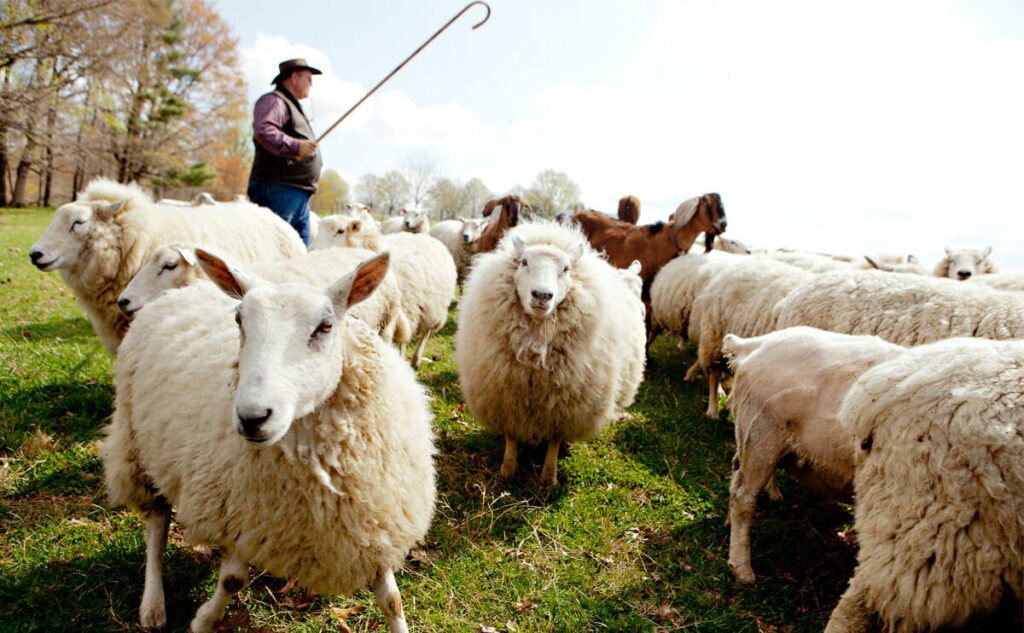
The picture at the top is from a fascinating article on what a shepherd has learned from lambs. There are some excellent observations that could be applied to church leadership—except maybe the bespeak about roasting sheep on a spit!
If yous enjoyed this, practice share it on social media (Facebook or Twitter) using the buttons on the left. Follow me on Twitter @psephizo. Like my page on Facebook.
Much of my work is done on a freelance ground. If you lot accept valued this post, you can make a single or repeat donation through PayPal:
Comments policy: Skillful comments that engage with the content of the post, and share in respectful debate, tin can add real value. Seek beginning to understand, then to exist understood. Make the near charitable construal of the views of others and seek to learn from their perspectives. Don't view argue as a disharmonize to win; accost the argument rather than tackling the person.
Source: https://www.psephizo.com/life-ministry/is-the-church-abandoning-its-flock/
0 Response to "Is the Church abandoning its flock?"
Enregistrer un commentaire